
AI Learning Platform Comparison: Which Tool Is Right for Students in 2026?
An AI learning platform uses machine learning to create, adapt, or personalize educational content in real time. The best platforms go beyond simply recommending the next video — they generate unique learning paths for each student based on their goals, current knowledge level, and the specific curriculum or exam they are preparing for.
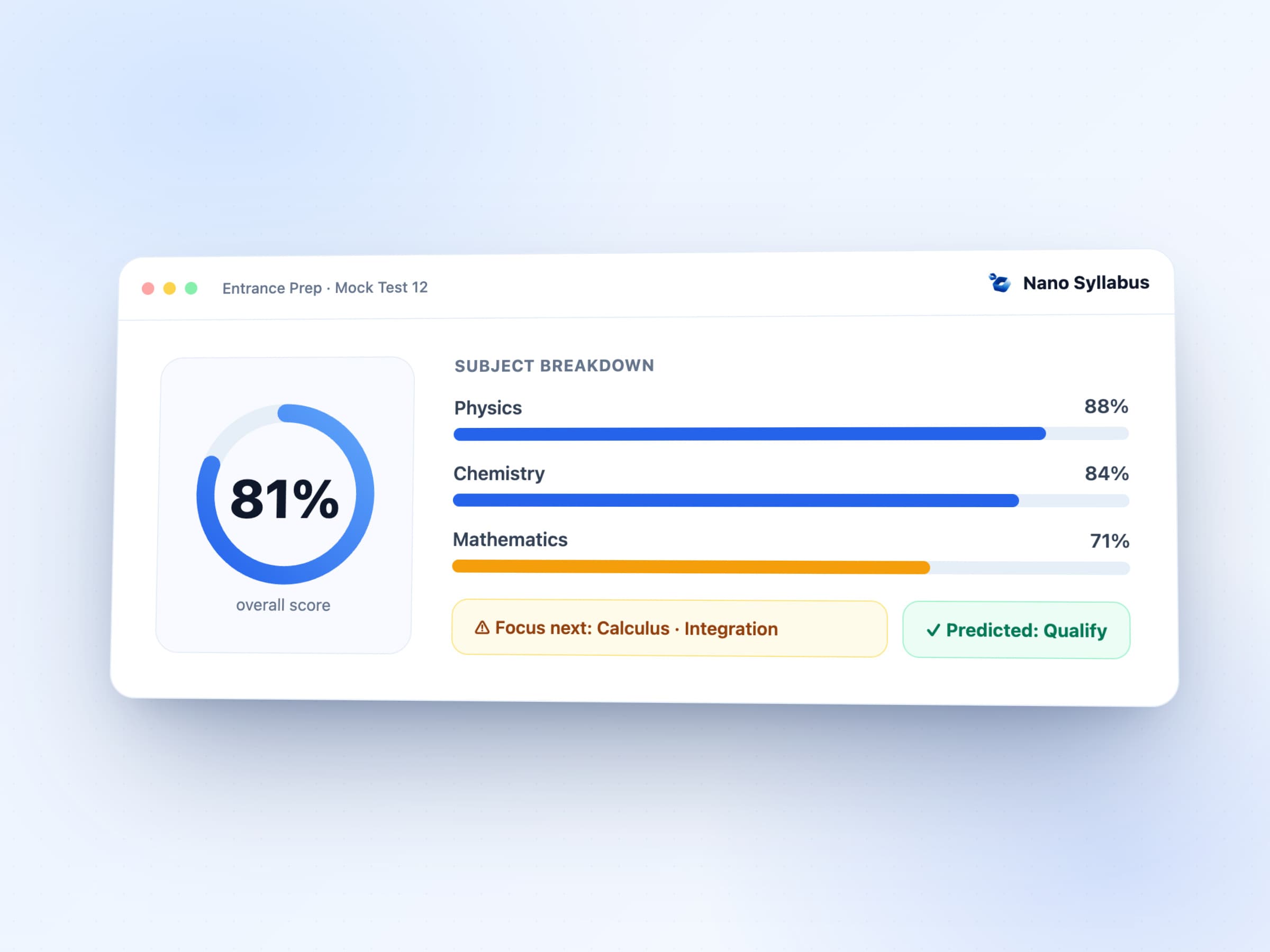
Quick Comparison
| Platform | Learning model | Your syllabus | Exam prep | Personalization | Free access |
|---|---|---|---|---|---|
| Nano Syllabus | AI-generated, curriculum-aligned paths | Yes | Yes | Full (per-student) | Yes |
| Khan Academy | Fixed video lessons + adaptive practice | Partial | No | Pacing only | Yes |
| Coursera | Fixed university courses | No | No | Recommendations only | Limited |
| ChatGPT | Open-ended conversational AI | No | No | None (manual) | Yes |
| YouTube | Video content (not a learning platform) | Some | Some | None | Yes |
Nano Syllabus
Nano Syllabus learns each student's exact syllabus. It is trained on the curriculum, past papers, and teacher notes a student is actually using — making it the only AI platform in this comparison that adapts to the specific syllabus a student is studying.
Strengths: directly aligned to your coursework and entrance exam materials; generates explanations in the style of a knowledgeable teacher; creates practice questions matched to exam patterns; doubt-solving engine that answers syllabus-specific questions; accessible on mobile with low data requirements.
Best for: students who want targeted exam preparation alongside curriculum revision, mapped to their own syllabus.
Khan Academy
Khan Academy is the world's largest free online learning platform, with millions of practice exercises and instructional videos. Its AI-powered tutor (Khanmigo) can answer questions and guide students through problems.
Strengths: free and comprehensive for core subjects; strong math and science libraries; adaptive practice pacing; well-translated into multiple languages.
Limitations: content follows a fixed general curriculum, not your specific syllabus; no exam-specific preparation; the Khanmigo AI tutor requires payment; does not know your exam's question patterns or marking schemes.
Best for: students who want a free supplement for mathematics and science concepts at a general curriculum level.
Coursera
Coursera offers courses from top universities (MIT, Stanford, Yale). It is primarily professional development and university-level content.
Limitations for school students: designed for university and professional learners; fixed course format with no adaptive personalization; most courses cost money; not aligned to school or entrance exam content.
Best for: students and professionals who want recognized certifications in specific skills (data science, business, programming) after completing school.
ChatGPT
ChatGPT is a general-purpose AI assistant that can answer questions, explain concepts, and generate practice problems on any topic. It is not a structured learning platform.
Strengths: can explain any topic on demand; free tier available; multilingual capability.
Limitations for exam preparation: no memory of what the student has studied before; does not know your syllabus or exam question patterns specifically; no structured learning path or progress tracking; students must direct every interaction manually.
Best for: ad-hoc question answering and concept clarification as a supplement to structured study, not as a primary learning platform.
The Fundamental Difference: Curriculum Alignment
The most important factor when evaluating an AI learning platform is curriculum alignment. A student preparing for a physics entrance exam needs practice questions drawn from that exam's question bank, explanations calibrated to the topics it tests, and a platform that knows its marking scheme and question type distribution.
Generic AI tools like ChatGPT and broad platforms like Coursera were not built with this in mind. They can provide general information but cannot replace a tool that genuinely knows your academic context.
Frequently Asked Questions
What is the best AI learning platform for students?
For students who want help aligned to their own coursework or a specific entrance exam, Nano Syllabus is the most directly relevant platform because it learns your syllabus, past papers, and exam patterns. For general curriculum or professional certification, Khan Academy (free) and Coursera (paid) are strong options.
What is the difference between an AI learning platform and traditional e-learning?
Traditional e-learning delivers fixed, pre-recorded content the same way to every student. AI learning platforms generate or adapt content based on each student's performance, knowledge gaps, and goals. The result is a more efficient learning path that focuses time where the student needs it most.
Can AI learning platforms help with exam preparation?
Yes, especially platforms aligned to a specific exam's syllabus and question patterns. A platform that knows the past papers, the topic weightings, and the common misconceptions tested in the exam can generate targeted practice far more efficiently than a student self-selecting problems from a textbook.
Is Nano Syllabus better than ChatGPT for studying?
For structured exam preparation, yes. Nano Syllabus is built as a learning co-pilot that learns your curriculum. ChatGPT is a general assistant with no memory, no learning path, and no knowledge of your syllabus. Students often use both: ChatGPT for ad-hoc questions and Nano Syllabus for structured preparation.
Which AI learning platform is free?
Nano Syllabus, Khan Academy, and the base tier of ChatGPT are all free to start. Coursera requires payment for most content.
How do AI learning platforms personalize education?
Effective AI learning platforms assess what a student already knows, generate a custom content sequence, monitor how the student responds to each piece of content, and update the path in real time. The depth of personalization varies: some platforms only adjust difficulty and pacing (adaptive), while others generate entirely new explanations and practice (generative).